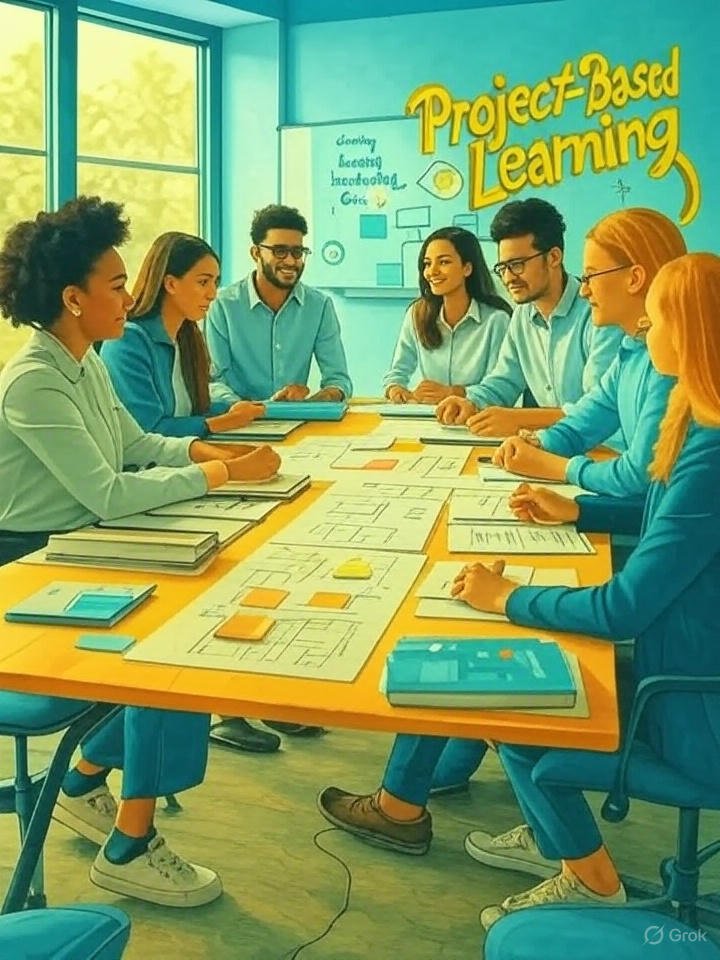
Project-Based Learning, or PBL, is a learning system that takes students away from traditional rote learning and toward solving real-life problems. This approach not only teaches students bookishness but also actively involves them in a meaningful project where they use their ideas, research, and creativity. In today’s fast-paced world, learning only theory is not enough. Now, employers prefer students who graduate with qualities such as practical skills, critical thinking, and teamwork, and all of these are achieved through PBL.
In this model, students are given a central question or problem whose solution they find for themselves. In this process, they go through multiple steps such as planning, researching, designing, and presenting. Every student has his/her role and together they achieve a common goal. Such projects not only improve their academic performance but also prepare them for life. In PBL, every student has to take responsibility for his/her learning, which makes them independent and self-motivated.
The trend of PBL is increasing in today’s classrooms because this method increases the engagement of students and creates a passion for lifelong learning in them. It has become an essential part of modern education.
Development of Real-World Skills:
The biggest advantage of Project-Based Learning is that it teaches students skills that are useful in their professional lives. When a student works on a project, he naturally learns skills such as planning, time management, communication, and leadership. These skills are very important for any job or career. Through PBL, students apply theoretical knowledge in a practical way, which deepens their understanding. For example, if a student is given a project related to the environment, he will research, collect data, analyse it, and then present his results – all these tasks happen like a real-life scenario.
In this process, students work together with others, which develops a spirit of teamwork and cooperation. Every student understands their role and fulfills their responsibility within the group. In this way, he learns to work well with people and share his ideas effectively. These skills are not only useful in the classroom but are also in demand in future jobs. Project-Based Learning not only makes students good learners but also makes them good problem solvers, communicators, and decision makers, which are essential for success in any career.
Increase in Student Engagement
Students often get bored in traditional lectures and lose interest. But when it comes to Project-Based Learning, student engagement increases because they are involved in a task that is both interesting and responsible. When students solve a real-life problem, they are more focused and active. They feel that their learning has a purpose, and they are working on something meaningful. This makes them feel more motivated and interested in the learning process.
In this learning style, every student works in his/her unique way. Some understand by drawing, some by writing, and some by analyzing data, and this flexibility boosts their creativity. When they have to present their project in front of others, they do even more preparation, which increases their confidence. Such activities create a sense of ownership in them. They feel that their work matters, and this feeling forces them to perform even better.
Project-Based Learning forces students to become active participants in the classroom instead of being passive listeners. They ask questions, seek solutions, and share their ideas. All of this plays an important role in their academic and personal growth.
Fostering Creativity and Critical Thinking
Another very important aspect of Project-Based Learning is that it promotes creativity and critical thinking in students. When students are given an open-ended project that can have multiple solutions, they come up with their ideas and start thinking of new ways. This process does not confine them to textbook knowledge but allows them to explore new perspectives. How they have to understand the problem, what information to use, and how to reach the solution – all this is a part of critical thinking.
The scope of creativity is very wide in PBL. Students use presentations, models, videos, or even digital tools in their projects, which help them convey their point more effectively. Every student is free to work in his/her way, which allows their thinking and approach to result in new insights. When they are given the freedom to explore ideas, they feel confident and trust themselves.
Critical thinking helps students learn to analyse everything. They do not accept things blindly but evaluate all the information. In today’s digital era, where misinformation is common, this skill makes them responsible and intelligent. In this way, PBL prepares them for future challenges.
Strategies to Implement Project-Based Learning:
Successfully implementing Project-Based Learning requires the use of certain strategies. First of all, teachers must understand that each student has a different learning style. Therefore, they must provide flexibility and choice when designing projects. Topics should be chosen that relate to real-life issues so that they can be of interest to the students. It is also very important to divide the projects into stages and set clear goals for each stage so that students do not get confused.
Another strategy is to promote collaboration. Students should be involved in group work where they can discuss their ideas and learn from each other. This develops their communication and teamwork skills. Teachers should play the role of guide only and let students handle their learning. It is also important to give regular feedback so that students can understand their mistakes and improve their work.
The method of assessment is also a bit different in PBL. The focus should not be just on the final product, but also on the process, research, and collaboration should be evaluated. The use of digital tools such as rubrics, online collaboration apps, and presentations also proves to be helpful in PBL implementation. By using all these strategies, teachers can create an engaging and effective learning environment.
Conclusion:
In today’s rapidly changing world, theoretical knowledge alone cannot take students forward. We need learners who are critical thinkers, creative and have the ability to solve practical problems. This is why Project-Based Learning has become an essential part of modern education. Through this learning model, students not only learn subjects but also prepare for life. Their confidence increases, they start thinking independently, and qualities like teamwork and leadership develop within them.
PBL gives real-life experiences to students which prepare them for future jobs. Employers prefer those candidates who come with skills along with knowledge. When students brainstorm to solve a problem, plan a solution and then practically complete it, it plays an important role in their overall development. This approach strengthens their self-learning and lifelong learning habits.
The important thing is that Project-Based Learning is not just a teaching method but a complete learning philosophy that prepares students to face the challenges of the 21st century. Teachers, schools and policy makers should come together and adopt this approach so that we can prepare a progressive and skilled generation.
FAQs:
1. What is Project-Based Learning (PBL) and how is it different from traditional learning?
Project-Based Learning is a teaching approach where students learn by actively engaging in real-life and meaningful projects. Unlike traditional rote learning, where students mainly memorize facts, PBL focuses on practical problem-solving, teamwork, research, and presentation. It encourages students to take charge of their learning and develop skills needed in the real world.
2. What kind of skills do students gain from Project-Based Learning?
PBL helps students develop essential skills such as critical thinking, creativity, communication, time management, leadership, and teamwork. These skills are not just useful in school but are highly valued in the workplace. Students also learn how to analyze problems, plan solutions, and present their ideas effectively.
3. How does Project-Based Learning increase student engagement?
PBL increases student engagement by involving them in projects that are relevant and interesting. Instead of passively listening to lectures, students work on tasks they care about. This sense of purpose motivates them to be more focused, creative, and confident. The variety in project activities also caters to different learning styles.
4. How can teachers effectively implement PBL in their classrooms?
Teachers can implement PBL by choosing real-world topics, encouraging group collaboration, breaking projects into stages, and providing regular feedback. It’s important to allow student choice and creativity. Teachers should act as guides, not just instructors, and use tools like rubrics, digital platforms, and presentations to support the learning process.
5. Why is PBL important in modern education?
In the modern world, employers seek candidates who can think critically, solve problems, and work well with others. PBL prepares students for these expectations by giving them real-world experience in learning. It builds independence, confidence, and lifelong learning habits, making it a key component of 21st-century education.