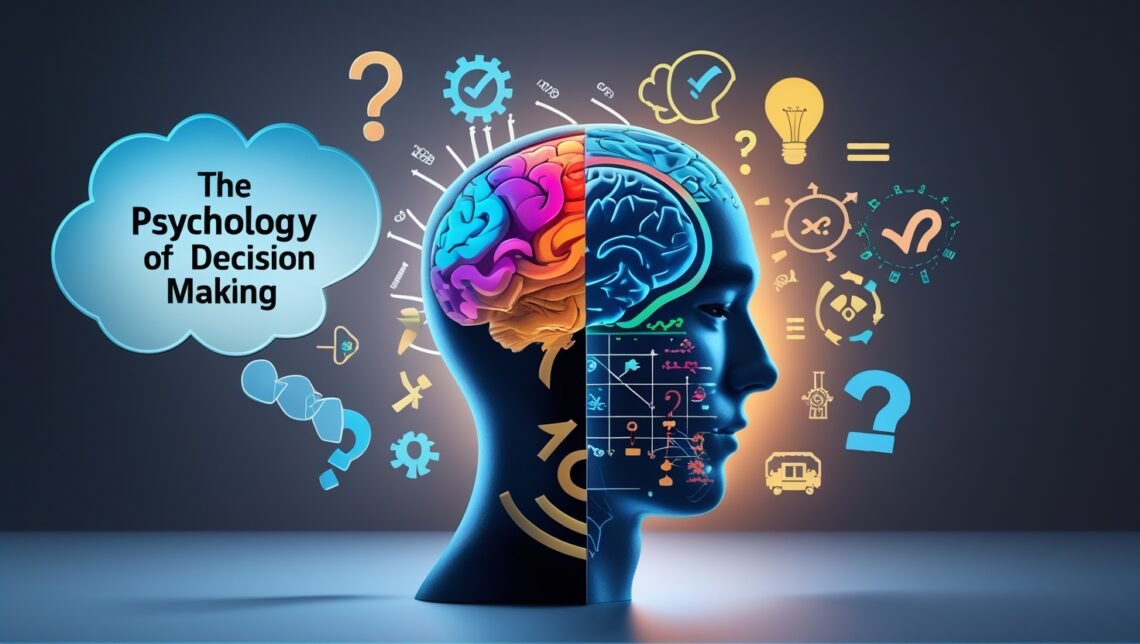
Every human being takes many decisions every day, some small like what to eat, and some big like career or marriage decisions. But how are these decisions taken? The answer to this question is hidden in an important part of psychology called “decision-making psychology”. Psychology tries to understand how the human mind works while making decisions, which factors influence them, and how our thoughts, feelings, and environment together determine our choices. Decision making is not just a logical process, it also involves emotions, past experiences, biases, and the influence of other people.
This blog will help you understand what cognitive processes lie behind decision-making, what the role of emotions is, and how we can avoid mistakes that often force us to make wrong decisions. It will also explain what impact society, culture, and environment have on our choices. In today’s modern era, where there is an overload of information everywhere, making the right decisions has become even more difficult. Therefore, it is very important to understand how we can make better and more thoughtful decisions that will be beneficial to us.
2. Cognitive Processes behind Decision Making:
When we make a decision, this process is not just a simple choice. Our brain works in a very complex way in this process. According to cognitive psychology, there are two basic systems in decision making: System 1, which is fast, automatic, and emotional; and System 2, which is slow, logical, and analytical. System 1 is activated when we instantly make a decision, like immediately accepting or ignoring a friend’s call. But if the decision is difficult, like which university to take admission in, then System 2 is activated, which does logical analysis.
It has also been seen that working memory, attention span, and problem-solving ability play an important role in this process. Our brain uses experience and knowledge to make better decisions in new situations. But many times we use shortcuts, i.e., “heuristics”, which do not work right all the time. Like liking something at first glance and accepting it without thinking.
Cognitive processes also decide how we compare options, analyze their pros and cons, and at what point we finalize one option. It is important to understand all these mental steps so that we can make our decision-making better.
3. Emotional Influences on Our Choices:
Emotions have a profound effect on human decision-making. When we are happy, angry, or stressed, our thinking and decision-making abilities change. For example, if a person is very happy, he or she is more interested in taking risks. Similarly, if someone is stressed or anxious, he or she may make more cautious or conservative decisions.
Psychologists say that emotions act as a guide for us. They tell us what we are feeling in a situation and how we should react accordingly. Sometimes we fall prey to emotional reasoning – like choosing something just because it makes us feel good at that moment, even if it will be detrimental in the long term.
Emotional intelligence is also important in this context. If a person knows how to understand and control their emotions, they can make better decisions. An emotionally aware person can also understand the feelings of others, which proves helpful in interpersonal decisions.
Ultimately, decision-making is a balance of both logic and emotions. It is not right to act only on emotions or even on logic. Only by understanding both and recognizing their meaning can we make better choices.
4. Social and Environmental Factors:
A person’s decision-making is never the result of their thinking. Society, environment, and other people have a deep influence on our choices. For example, if your friends like a brand, you too subconsciously lean towards that brand. This is called peer pressure, which is often very high among young adults.
Media and social networks also influence our thinking. The information, trends, and viral content we get all the time shape our preferences. It often happens that after seeing something repeatedly, we adopt it without analyzing its pros and cons.
Cultural values also play an important role in decisions. Every culture has different norms that define “right” or “wrong” for people. For example, in some cultures, group decision making is preferred, while in some, individual choice is preferred.
If the environment is positive, like a peaceful atmosphere, supportive people, and constructive feedback, then making decisions is easy, whereas a negative environment leads to confusion, doubt, and stress. Therefore, it is very important to understand which people and situations influence us when making our decisions.
5. Common Biases and Errors in Decision Making:
The human brain is very efficient, but sometimes it makes us take shortcuts and make mistakes. These mental shortcuts are called “biases” in psychological language. These biases force us to make mistakes in our decisions, often without our realizing it.
One common bias is confirmation bias, in which we only look for information that supports our preconceived ideas and ignore information that goes against them. Another is overconfidence bias, when we overestimate our abilities or knowledge and make risky decisions.
Another interesting bias is anchoring bias, in which the first information we receive influences our final decision in a disproportionate way. For example, if the initial price of a product is Rs. 5,000 and after a discount it is Rs. 3,000, we feel that it is a good deal, even if the actual price is not that much.
Apart from these, there are several other biases, such as availability heuristic, status quo bias, and loss aversion, which affect our everyday decisions. It is important to understand these biases so that we can recognize the workings of our mind and avoid traps that may lead us in the wrong direction.
6. Conclusion:
Finally, when we consider all psychological aspects, cognitive processes, emotional feelings, social influences, and biases, we realize that decision-making is a complex but manageable process. It can be improved if we take stock of our thinking and environment.
The first step to making better decisions is self-awareness. When we begin to understand how we are logical and how we are emotional, then we can modify our decisions in a better way. Emotional regulation is also important; do not react on impulse all the time.
The second step is critical thinking. The pros and cons of each option should be analyzed objectively. Do not settle on a particular option just because it seems familiar. New choices should be explored and decided upon with rational thinking.
Finally, taking feedback and learning from others’ experiences also helps in decision-making. Not every decision is right, but something can be learnt from every decision. When we understand our mistakes and take the next step, only then can we make the decisions of our lives more effective and meaningful.
FAQs:
1. What is decision-making psychology and why is it important?
Decision-making psychology is a branch of psychology that studies how people make choices—whether small, like what to eat, or large, like choosing a career. It explores the mental, emotional, and social factors involved in making decisions. Understanding this helps us improve our thinking, avoid mistakes, and make smarter life choices.
2. How do cognitive processes affect the decisions we make?
Cognitive psychology explains that we use two mental systems: System 1, which is fast and emotional, and System 2, which is slow and logical. System 1 helps in quick decisions, like reflexes, while System 2 is used for careful analysis. Our memory, attention, and problem-solving skills also play a key role in comparing options and reaching conclusions.
3. In what ways do emotions influence our decisions?
Emotions shape our decisions by affecting how we react to situations. For example, happiness can make us take more risks, while stress can lead to cautious choices. Emotional intelligence—understanding and managing our emotions—helps us avoid impulsive mistakes and make more balanced decisions.
4. How do social and environmental factors shape our choices?
Our surroundings and social relationships heavily influence our decisions. Peer pressure, cultural norms, media trends, and even the physical environment can shape our behavior and preferences. Recognizing these outside influences can help us stay true to our personal values and avoid being blindly influenced.
5. What are some common biases that lead to poor decisions?
Biases are mental shortcuts that sometimes mislead us. Confirmation bias makes us seek info that supports our opinions. Overconfidence bias causes us to overestimate our knowledge. Anchoring bias locks our judgment on first impressions. Being aware of these biases can help us think more clearly and avoid decision-making traps.